
THE "TEAM GEAR" OR "STRETCHER-STRESSOR" - SCREENING EXERCISES/ACTIVITIES FOR MILITARY, LAW ENFORCEMENT, FIRST RESPONDERS, RESCUE UNITS, AND MORE

Updated: Oct 16, 2025
Disclaimer: The content provided by Dr. Moran Sciamama-Saghiv on physical screening for military, law enforcement, and similar professions is intended solely for educational and informational purposes. It does not constitute medical, legal, or professional advice, nor does it establish any professional relationship. Readers must obtain proper medical clearance and institutional authorization before applying any information. Dr. Sciamama-Saghiv disclaims all liability for injury, loss, or misuse of the material.
I am Dr. Moran Sciamama-Saghiv, ex-Army officer and an expert of many years on screening processes (especially yet not limited to military with an emphasis on special forces; physical aspects). I offer consultation services and a variety of lectures related to the Israeli military. I would be happy to collaborate with you (if and when relevant). In the meanwhile, I invite you to read my blog post series on the screening processes for military, law enforcement, rescue units, first responders, etc.
In a previous series of blog posts, I have surveyed the multiple and diverse aspects of how to establish or improve a physically-based screening process for military, law enforcement, first responders, rescue units, and more. In this series we will focus on actual suggestions for exercises/activities that can be used in a screening process, and possible variations. Each blog post in the series will analyze the elements that the screening activity requires, "pros" and "cons", "do" and "don'ts", and how the screening activity serves as a tool in the hands of the evaluators.
In some cases, there is more than one way to conduct the exercise, analyze it, or experience it. We will survey both physically-based screening exercises/activities, and non-physical screening exercises/activities. Furthermore, many screening exercises are planned in a way that your ability to prepare for them is limited as much as possible (even with previous knowledge and practice) or simply are meant to examine if you meet the minimum requirements and nothing more.
This screening exercise is very similar to the "two lines or too late" screening activity, and is a physically-based exercise/activity that is meant to determine the candidates' ability to deal with increasing physical difficulty and examine the candidates' strategic thinking, determination to be noticed, fitness, and competitiveness. It is also great to see if candidates "pick up" on changing realities, circumstances, and rules of engagement. This screening activity conflicts candidates with extreme physical hardship, and their resolution to do well and excel, as well as reach a "mind over body" status of existence where physical pain is overcome in favor of performance.
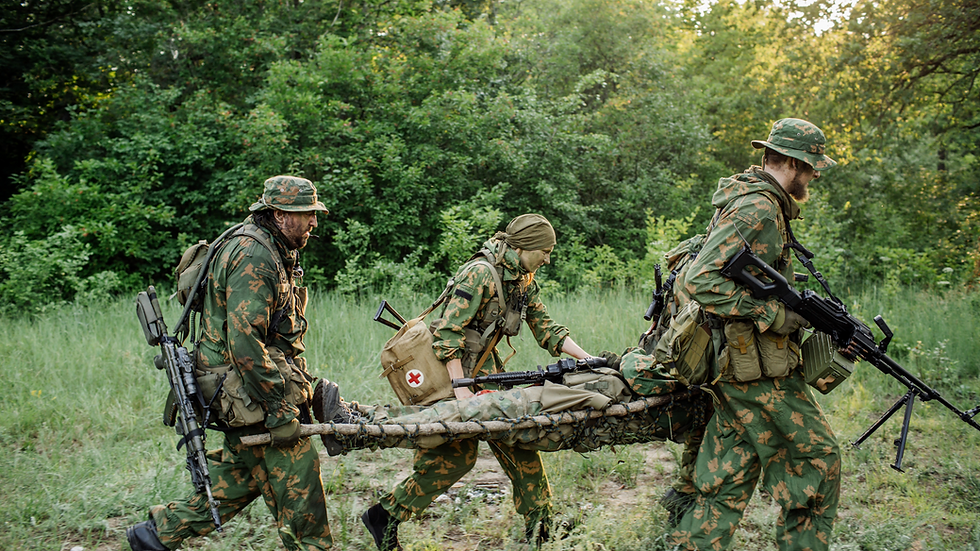
The screening exercise begins with all candidates of a team/group standing behind a predetermined line ready to "take off" at the instructor's signal. The goal is to reach the top of a steep hill where their team equipment is located. The most basic equipment includes a stretcher loaded with 70 - 80 Kg (154 - 176 lbs) of sandbags, one 20L (5.4 American gallon jerrycan), and one 10L (2.7 American gallon jerrycan).
Instructions only include:
Must sprint to the top of the hill where the equipment is - walking or "jogging" do not count at all.
First four candidates must carry the stretcher (no choosing what to carry). The first candidate to arrive is located in front to the right, the second candidate to arrive is located in front to the left, the third candidate to arrive is located in the back to the right, the fourth candidate to arrive is located in the back to the left, the fifth candidate to arrive carries the 20L jerrycan, while the sixth candidate to arrive carries the 10L jerrycan.
The equipment carriers must then return to the beginning point carrying the equipment.
The way back (downhill) is by walking only! - safety first.
All other must reach the top of the hill and then return to the beginning point.
Candidates openly get more points the faster they reach the top of the hill and according to their location getting back to the beginning point.
The exercise dynamics are created by three types of interactions between the candidates and the instructors:
The instructors are encouraged to constantly engage the candidates in a negative way (negative feedback, demoting their performance, mocking their performance).
The instructors are encouraged to constantly find reasons why the candidates' attempts does not count (they sprinted for nothing).
The number of candidates acknowledged for their effort constantly decreases until only the candidate coming in first counts.
This upside down physical funnel requires that they run faster as they get more and more tired/fatigued, increasing the psychological challenge.
The screening exercise can be developed in multiple versions and/or directions. These may include the following:
The distance of sprinting. Greater distance means greater hardship yet more opportunity to pass another candidate.
The slope of the terrain - is it flat, uphill, downhill? - uphill advised...
When is the signal to "take off" given again? is it only after all candidates have arrived? is it before everyone has returned (increasing the pressure on the least of the performers)? does it keep changing? is it in the middle of interacting with the candidates to send a message there are "no rules"?
How many candidates are acknowledge for their attempt - indicated by writing their name in the instructors' pocket books. Not written means not important.
Are they sprinting to and back which includes a direction change and the possibility of cheating (if they do not actually cross the other marker/line)? are they running one way, which increases the speed they tend to run, and how little a difference in speed can mean a great difference in the results?
Do they "announce" their locations as they achieved to cause them to talk while hyperventilating?
Are we asking them questions to stress them physically (talking while hyperventilating) and psychologically?
Do we officially challenge some of them to improve by indicating a result that is better than what they just achieved? - this may encourage whoever came in first since they have nothing to improve...
Do we penalize or punish under-performers? consider the role of physical punishment and its long-term implications of associated physical activity with punishment.
How much personal gear and/or equipment are they carrying?
Are the jerrycans full? half full? one is full and the other less or not at all full?
Do we add a seventh piece of equipment? an eighth?
Do we gradually increase the weight on the stretcher until the maximum allowed/chosen?
Do we put the candidate that arrived last on the stretcher as a means of demotion (increasing the motivation not to come in last)?
Other?
Curious? need help? have questions? - contact me!
Register for FREE and get notified every time a new post is added to KIIP by Dr. Saghiv's website. Stay updated all the time with added blog posts about health, wellness, kinesiology, talent acquisition, job seeking, leadership, military service, and more.

Services by Dr. Moran Sciamama Saghiv:
Tags associated with this blog post include:
military training, law enforcement, rescue operations, first responders, tactical gear, combat readiness, special forces, counterterrorism, homeland security, border patrol, police units, fire department, paramedics, emergency medical services, disaster relief, crisis response, search and rescue, military tactics, SWAT team, defense forces, national guard, army rangers, navy seals, coast guard, air force, marines, peacekeeping missions, riot control, crowd management, protective services, K9 units, hostage rescue, urban warfare, cyber defense, intelligence operations, surveillance systems, command and control, mission planning, operational readiness, rapid deployment, humanitarian aid, emergency response teams, firefighter training, hazmat units, bomb disposal, EOD units, medical evacuation, field hospitals, casualty care, tactical medicine, active duty, reserve forces, veterans support, homeland defense, protective gear, ballistic protection, armored vehicles, military strategy, law enforcement training, disaster preparedness, mass casualty response, community policing, critical incident management, incident command system, firefighting equipment, emergency drills, tactical operations, anti-smuggling units, narcotics enforcement, crime prevention, forensic units, traffic control, security checkpoints, border security, peacekeeping forces, relief operations, combat engineers, evacuation protocols, emergency shelters, public safety, crisis communication, interoperability, mutual aid, civil defense, air rescue, water rescue, mountain rescue, survival training, situational awareness, chain of command, operational security, threat assessment, risk management, protective intelligence, officer safety, emergency dispatch, communications systems, emergency coordination, resilience training, field operations, emergency logistics, lifesaving interventions.


Comments